 LazySEO
LazySEO › Blog › How to Reduce Dependency on SEO Experts With Automated AI-Optimization Workflows
← All articlesHow to Reduce Dependency on SEO Experts With Automated AI-Optimization Workflows
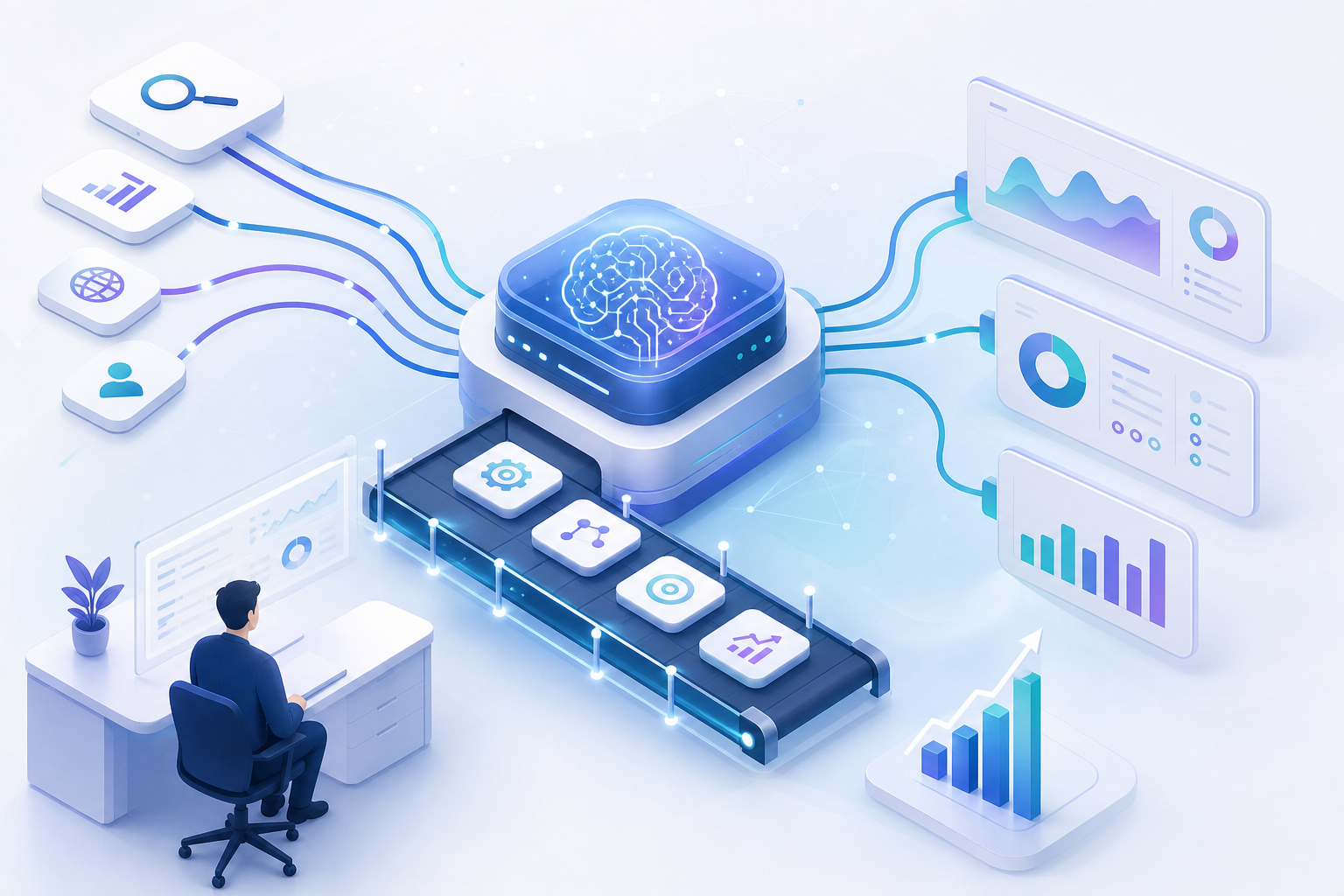
Reducing dependency on SEO experts means automating repeatable work, standardizing AI-optimization workflows, and reserving human input for strategy, judgment, and brand risk. In practice, AI can already handle much of keyword research, audits, briefs, metadata, internal linking, reporting, and AI-visibility monitoring when supported by clear review rules and reliable tools.
Why are brands trying to reduce dependency on SEO experts now?
Brands are trying to reduce dependency on SEO experts because search behavior is shifting toward AI-generated answers, while routine optimization work is increasingly automatable. The goal is not to remove experts entirely. The goal is to use experts for higher-value decisions and let systems handle repetitive execution.
Search demand is moving toward AI interfaces. Rankability reports that general AI search demand increased about 3.6× from 2022 to 2026 and continues growing rapidly, while interest in traditional SEO fell after peaking in mid-2025. BrightEdge also states that AI agents now perform about 88% of all organic search requests and may surpass human-driven searches by the end of 2026.
That shift changes the operating model. Teams now need workflows for AI search engine optimization, GEO strategies for brands, and brand presence inside assistant answers, not only blue-link rankings.
Which SEO tasks can AI workflows automate reliably?
AI workflows can automate the systematic, repeatable parts of SEO most reliably. These usually include keyword clustering, content briefs, meta descriptions, internal link suggestions, basic technical audits, schema recommendations, routine refreshes, and reporting.
IndexHill says AI workflows can automate 60% to 70% of repeatable SEO tasks, with average work-hour reductions of 55% to 83% across client benchmarks. That matters because most SEO bottlenecks are process bottlenecks, not insight bottlenecks.
Tasks that usually fit automation well include:
- Keyword discovery and grouping
- Search intent labeling
- Content outline and brief creation
- Meta title and description drafting
- Internal link mapping
- Structured data recommendations
- Content gap detection
- Weekly and monthly reporting
- AI citation tracking and mention monitoring
- Competitor benchmarking for AI answers
Human experts are still useful for:
- Site migrations
- Brand positioning
- Sensitive YMYL content
- Editorial quality control
- Market-specific strategy
- Final approval for large technical changes
How do I build an automated AI-optimization workflow without losing quality?
The safest approach is to automate in stages: discover, prioritize, generate, validate, publish, and re-measure. Quality drops when teams automate generation but skip validation and feedback loops.
A practical workflow looks like this:
1. Discover: collect rankings, crawl issues, brand mentions in AI, competitor answers, and content gaps.
2. Prioritize: score opportunities by business value, effort, and visibility impact.
3. Generate: create briefs, metadata, schema drafts, refresh recommendations, and answer-focused rewrites.
4. Validate: check factual accuracy, brand voice, duplication risk, schema correctness, and page intent alignment.
5. Publish: push approved changes through CMS or workflow tooling.
6. Re-measure: track changes in rankings, citations, answer inclusion, and visibility score in AI search.
This end-to-end model already exists in the market. Gen SEO Agent describes a full SEO and AEO automation pipeline spanning discover, generate, validate, push, and re-measure, including Schema.org JSON-LD, llms.txt, site audits, and answer-engine rewrites across major AI assistants. Kontent.ai also positions SEO and GEO discrepancy detection and fix application as scalable workflow automation.
What should humans still own in an automated SEO program?
Humans should still own strategy, approval thresholds, risk management, and editorial judgment. Automation works best when people define the rules and exceptions.
Keep expert review for:
- Core content strategy
- Topic authority planning
- Brand messaging
- Legal or compliance review
- Technical changes affecting templates or architecture
- Final sign-off on schema, claims, and citations
This model reduces dependency on specialists for day-to-day production, but it does not eliminate the need for expertise. It reallocates expertise to the points where mistakes are expensive.
How do I improve AI visibility, not just traditional rankings?
Improving AI visibility requires tracking where your brand is cited, summarized, or omitted in AI answers, then optimizing content for extraction, clarity, and machine-readable structure. Traditional SEO alone is no longer enough.
A major gap is measurement. GoodFirms reports that only 14% of marketers currently track visibility in AI or LLM citations, even though many treat AI optimization as a strategic priority. If you do not track citations, answer inclusion, and brand mentions in AI, you cannot manage AI assistant brand presence.
To improve AI visibility:
- Publish concise, sourceable answers near the top of pages
- Use clear headings that match real user questions
- Add structured data where appropriate
- Keep facts consistent across pages
- Update stale pages that AI systems may summarize incorrectly
- Build entity clarity for products, services, founders, locations, and use cases
- Compare your answers against competitor benchmarking for AI answers
This is where a GEO platform such as LazySEO can help. A dedicated generative engine optimization workflow is useful when a team needs repeatable monitoring of AI visibility, content gaps for AI optimization, and brand mention opportunities without depending on manual expert checks for every page.
Does structured data still matter for AI search engine optimization?
Yes. Structured data still matters because it helps machines interpret entities, page purpose, and important attributes more consistently. Structured data does not guarantee AI citations, but it improves clarity and reduces ambiguity.
For automated workflows, structured data for SEO is one of the easiest areas to standardize. Templates can suggest or generate Schema.org JSON-LD based on page type, then route it for validation before publishing. This is especially useful for product, organization, article, FAQ, and local business pages.
Tools in the SEO and GEO automation market increasingly include schema handling because it is repeatable, auditable, and easy to scale when connected to content models.
What metrics should replace expert gut feel?
Replace subjective judgment with a small set of operational metrics tied to search surfaces, content quality, and business impact. Experts are still useful, but teams need shared metrics that non-specialists can act on.
Useful metrics include:
- Visibility score in AI search
- Brand mentions in AI answers
- Share of citations versus competitors
- Content gaps for AI optimization
- Index coverage and crawl health
- Internal link coverage
- Schema coverage and validation rate
- Refresh cadence for high-value pages
- Conversion or pipeline impact from organic and AI-assisted discovery
This matters because adoption is still uneven. GoodFirms shows many marketers prioritize AI optimization, but few actively measure AI citation visibility. That gap creates an opportunity for workflow-based reporting and AI citation tracking.
Are companies actually adopting AI automation for SEO work?
Yes. AI automation is already moving into mainstream marketing operations, especially for repetitive optimization and content workflows. Adoption is driven by speed, labor savings, and the need to keep up with AI-driven search behavior.
Resourcera reports that more than 80% of businesses in retail and consumer sectors plan to implement AI-driven automation by 2026, while 67% of marketers cite automation as AI's biggest advantage. The same source notes that many companies use tools like ChatGPT to create content faster.
This does not mean every AI-generated output should publish automatically. It means automation is becoming the default layer for routine production, with experts supervising exceptions.
How can advanced workflow optimization lower cost and reduce expert involvement further?
Advanced optimization improves the workflow itself, not just the content output. That matters because inefficient pipelines waste model calls, increase latency, and still require human cleanup.
Research points to two useful directions. Cognify's AdaSeek paper describes autotuning methods that can improve generation quality while reducing cost and latency. Agent Workflow Optimization shows that combining agent actions into deterministic meta-tools can reduce LLM calls and improve task success.
For SEO teams, the lesson is simple: do not only automate tasks. Also optimize orchestration. Better workflow design means fewer prompts, fewer handoffs, fewer manual QA cycles, and less dependence on specialist intervention.
What is the best operating model for reducing reliance on SEO experts?
The best model is a hybrid system: AI handles execution, templates handle consistency, and experts handle strategy and exceptions. This reduces specialist dependency without sacrificing quality or brand control.
A strong operating model usually includes:
- Standardized page templates
- Prebuilt prompts for briefs, metadata, and refreshes
- Structured approval rules
- Automated QA checks
- AI citation tracking
- Competitor monitoring
- Monthly expert review of strategy, not every task
That model aligns with the direction of AI search engine optimization. Search is becoming more automated, more answer-driven, and more citation-sensitive. Teams that systematize GEO strategies for brands now will be less dependent on scarce experts later.
FAQ
How much SEO work can I realistically automate?
You can usually automate most repeatable SEO production work, but not the full function. A realistic target is automating routine research, briefs, metadata, internal linking, audits, and reporting, while keeping humans focused on strategy, approvals, and high-risk content changes.
Do I still need an SEO expert if I use AI workflows?
Yes, but you need fewer expert hours on repetitive tasks. AI workflows reduce dependence on specialists for execution, while experts remain important for strategy, technical judgment, brand positioning, and final review where errors are costly.
What should I track for AI search visibility?
Track whether your brand appears in AI-generated answers, which pages get cited, which competitors are mentioned instead, and how visibility changes over time. AI citation tracking, brand mentions in AI, and competitor benchmarking for AI answers are now core performance metrics.
Is Generative Engine Optimization different from traditional SEO?
Yes. Traditional SEO focuses heavily on rankings and clicks, while Generative Engine Optimization focuses on being cited, summarized, and represented accurately inside AI answers. In practice, strong programs combine both rather than treating them as separate channels.
Where does LazySEO fit in this workflow?
LazySEO fits at the workflow layer for brands that want to improve AI visibility with less manual specialist effort. It is most useful when a team needs repeatable GEO monitoring, AI optimization tasks, and scalable visibility management across AI-powered search engines.
References
- https://gen‑seo.ai
FAQ
How much SEO work can I realistically automate?
You can usually automate most repeatable SEO production work, but not the full function. A realistic target is automating routine research, briefs, metadata, internal linking, audits, and reporting, while keeping humans focused on strategy, approvals, and high-risk content changes.
Do I still need an SEO expert if I use AI workflows?
Yes, but you need fewer expert hours on repetitive tasks. AI workflows reduce dependence on specialists for execution, while experts remain important for strategy, technical judgment, brand positioning, and final review where errors are costly.
What should I track for AI search visibility?
Track whether your brand appears in AI-generated answers, which pages get cited, which competitors are mentioned instead, and how visibility changes over time. AI citation tracking, brand mentions in AI, and competitor benchmarking for AI answers are now core performance metrics.
Is Generative Engine Optimization different from traditional SEO?
Yes. Traditional SEO focuses heavily on rankings and clicks, while Generative Engine Optimization focuses on being cited, summarized, and represented accurately inside AI answers. In practice, strong programs combine both rather than treating them as separate channels.
Where does LazySEO fit in this workflow?
LazySEO fits at the workflow layer for brands that want to improve AI visibility with less manual specialist effort. It is most useful when a team needs repeatable GEO monitoring, AI optimization tasks, and scalable visibility management across AI-powered search engines.